Altitude Shifts and Humidity Challenges: Impacts on Athletic Performance in Mountainous and Seaside Locations
Written by Hugo Butler · May 23, 2026
Altitude Shifts and Humidity Challenges: Impacts on Athletic Performance in Mountainous and Seaside Locations
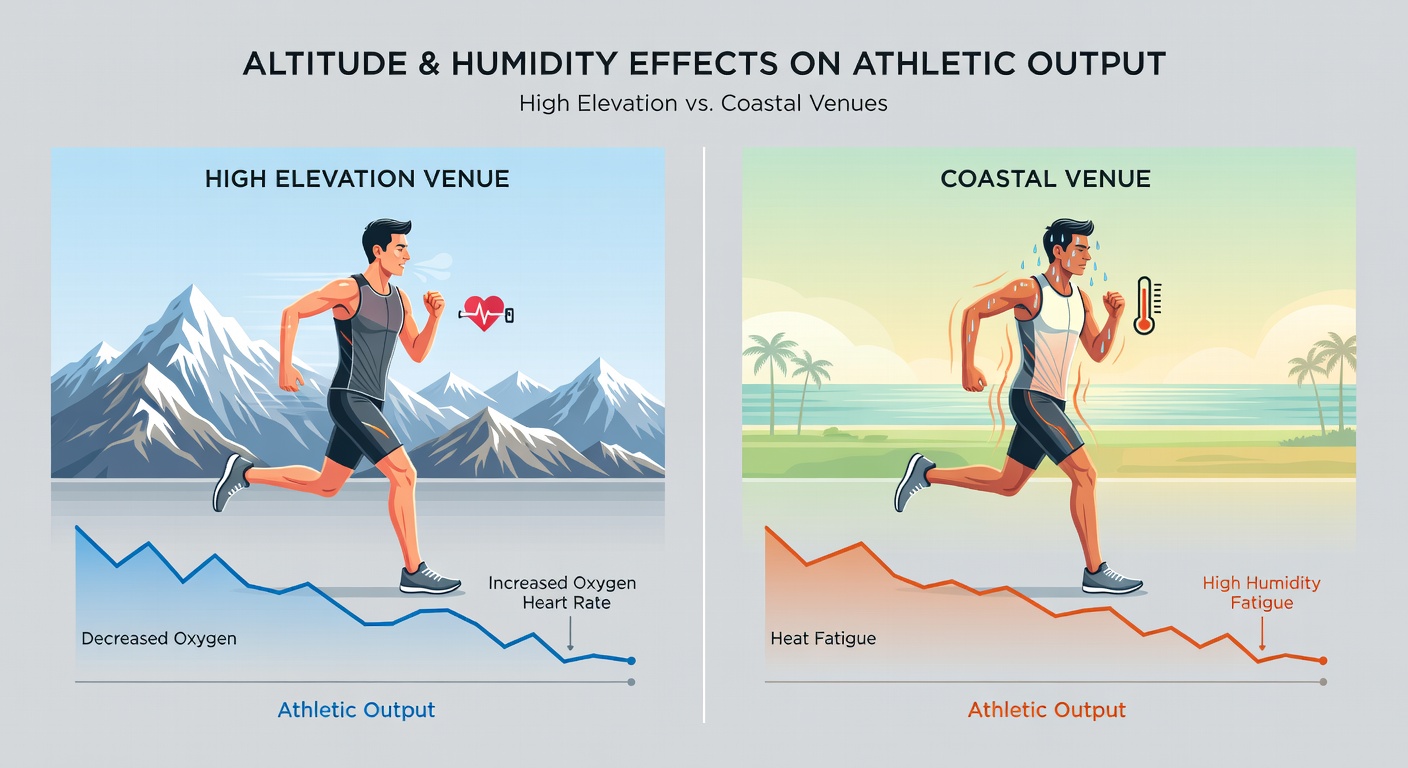
High elevation venues create thinner air that reduces oxygen availability while coastal sites often bring elevated moisture levels that complicate body temperature regulation; researchers have documented these environmental variables across multiple sports and training protocols since the mid twentieth century. Studies from institutions such as the University of Colorado and the Australian Institute of Sport show measurable declines in endurance output when athletes move between these contrasting settings, and data collected during events in May 2026 continue to highlight the same physiological patterns.
Physiological Responses to Reduced Oxygen at Elevation
At altitudes above 1500 meters the partial pressure of oxygen drops, prompting immediate increases in breathing rate and heart rate as the body attempts to maintain adequate oxygen delivery to working muscles. Observers note that elite endurance athletes experience a drop in maximal oxygen uptake that can reach 10 to 15 percent when they first arrive at venues such as Mexico City or Denver, yet repeated exposure over several weeks triggers increased red blood cell production that partially restores capacity. Short duration power events suffer less because they rely primarily on anaerobic pathways, but repeated sprint sports still show accumulated fatigue when recovery intervals occur in thinner air.
Humidity Effects on Thermoregulation and Fluid Balance
Coastal environments frequently combine high relative humidity with warm temperatures, limiting evaporative cooling because sweat remains on the skin rather than vaporizing efficiently. Research indicates that core body temperature rises faster under these conditions, forcing athletes to reduce intensity to avoid heat related impairment even when ambient temperatures appear moderate. Data collected during matches in Miami and Singapore reveal dehydration rates that exceed those recorded at drier inland sites of similar temperature, because athletes often underestimate fluid losses when visible sweating appears reduced.
Combined Stressors in Real World Competition Settings
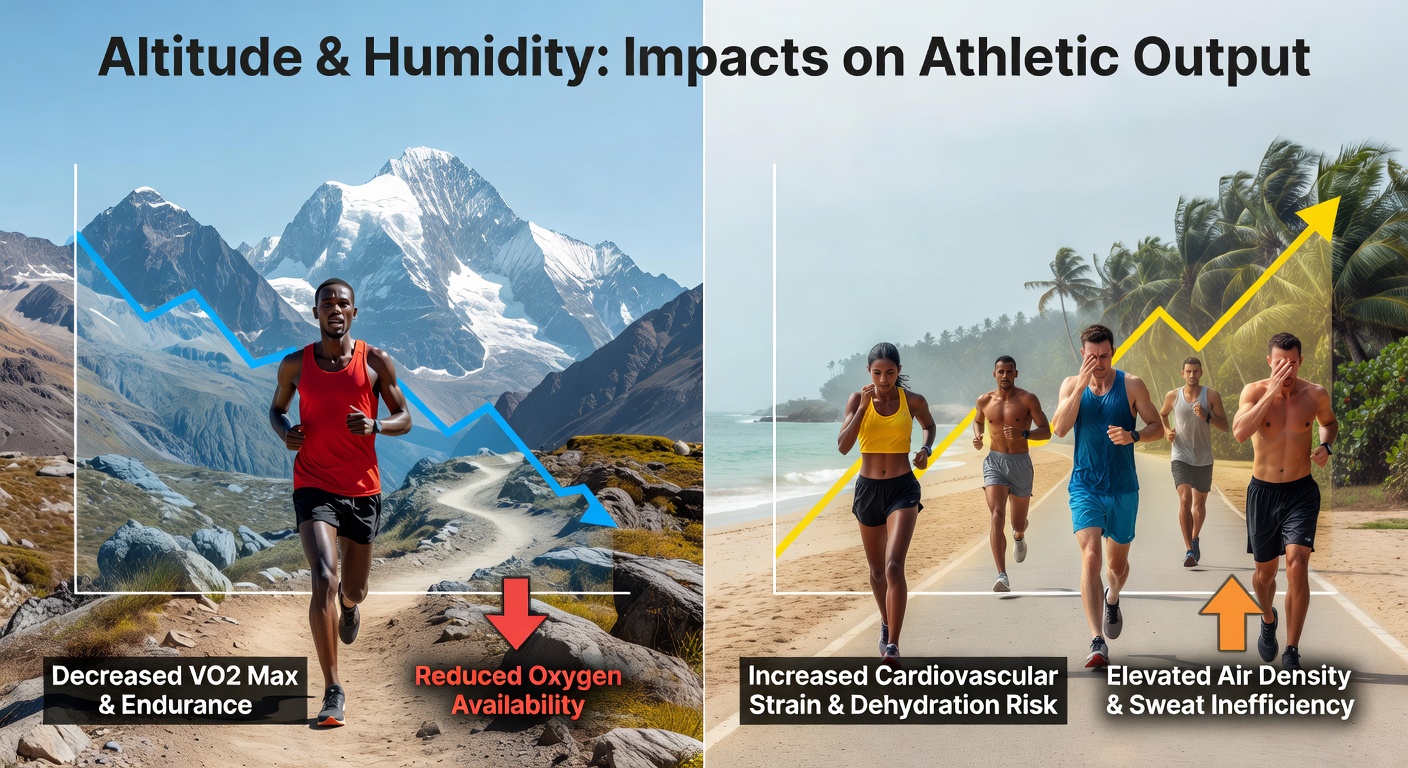
When athletes travel from high elevation training camps to humid coastal competitions the dual challenge emerges within a short window, and performance metrics collected by sports science teams reflect the interaction rather than isolated effects. For instance a soccer squad that prepares in the thin air of the Colorado Rockies then plays a match in a humid Gulf Coast stadium encounters both reduced oxygen delivery during the first half and accelerated glycogen depletion caused by inefficient cooling in the second half. Tracking data from May 2026 tournaments show average distance covered per player declining by roughly six percent under these transitions compared with matches held entirely at sea level or entirely at moderate altitude.
Documented Performance Variations Across Sports
Distance running events display the clearest altitude penalties because sustained aerobic metabolism dominates; world records set at sea level remain untouched at elevations above 2000 meters. Team sports such as basketball and volleyball experience subtler but consistent drops in late game output when humidity prevents full recovery between quarters or sets. Strength based disciplines including weightlifting show minimal direct influence from either factor, although recovery between attempts can lengthen if ambient moisture slows heat dissipation. Studies published by the American College of Sports Medicine and by research groups in Canada have quantified these differences using standardized protocols that control for fitness level, acclimatization status, and hydration practices.
Acclimatization Timelines and Practical Adjustments
Full hematological adaptation to altitude typically requires two to three weeks, yet partial improvements in oxygen utilization appear within four to seven days according to longitudinal monitoring of national team athletes. Humidity acclimatization occurs more rapidly, often within five to ten days, as sweat glands become more efficient and plasma volume expands. Teams preparing for events that move between elevation zones and coastal arenas therefore schedule staggered arrival times and incorporate controlled heat and altitude exposures in the weeks leading up to competition. Monitoring tools that track heart rate variability, sleep quality, and morning body mass help coaching staff identify when athletes have not yet reached stable physiological baselines.
Measurement Technologies and Ongoing Data Collection
Portable metabolic carts, wearable oxygen saturation sensors, and environmental data loggers now allow continuous recording of conditions inside stadiums and on training fields. Organizations such as the International Olympic Committee and various national sports institutes compile these datasets to refine scheduling guidelines and medical support protocols. Figures released in early 2026 from multi venue tournaments confirm that venues combining elevation above 1800 meters with relative humidity above 70 percent produce the largest cumulative decrements in total work output across a full match or race.
Conclusion
Environmental conditions at high elevation venues and humid coastal sites impose distinct physiological demands that alter athletic output in measurable ways; the extent of those alterations depends on sport type, individual acclimatization status, and the specific combination of altitude and moisture present on competition day. Continued collection of field data supports evidence based preparation strategies that allow athletes to mitigate but not eliminate the effects of these natural variables.